“To
travel is to eat.” – Michelle Shappirio
Indeed, in order to travel, we must partake of the country's cuisine. For the past 10 months, we had travelled so many different
parts of Asia via its cuisine. We first began with Japan, Thailand, West Asia,
Hong Kong and Macau, Indonesia, Korea, Indian Subcontinent, Indo China, Philippines
and Taiwan. For the round-up of Taiwan, do hop over to Alan’s blog to take a
look at the delicious food contributed by various bloggers. For the finale of
Asian Food fest, Singapore would be the last country featured.
Before we immerse into the unique food culture of Singapore, it
would be essential to understand the origins of Singapore.
In 1819, Singapore was developed as a British trading port
under the joint treaty with British and the Sultan of Johor. During the World War II, Singapore was occupied by the
Japanese until the British repossessed it in September 1945 upon Japan’s
surrender. However, Singapore gained its independence from the United Kingdom
on 31 August 1963 and joined with Malaysia to form the new Federation of
Malaysia due to its concerns for limited land size and scarcity of land, water,
markets and natural resources. On 9 August 1965, Singapore officially separated
from Malaysia and gained its independence as the Republic of Singapore.
Upon receiving independence from the United Kingdom in 1963,
most of Singapore’s new citizens were labourers from Malaysia, China and India.
There is also a minority group of middle-class, locally born people known as
Peranakans which are a hybrid of Chinese and Malay. Hence, this created a new
Singaporean identity and culture. Singapore has a predominant Asian population
where 75% are Chinese with significant minorities of Malays, Indians and
Eurasians. This makes it a very diverse country with its many languages,
religions and cultures.
In Singapore, food is pegged to its national identity and
binds various cultures together. If you have heard that eating is Singapore’s
national pastime, you have not heard wrongly. It is indeed a national
obsession. Despite this, religious dietary restrictions still exist where
Muslims do not eat pork, Hindus do not eat beef and Chinese Buddhists do not
eat beef as well as an increasing group of vegetarians.
In order to understand more about Singapore cuisine, let us
take a quick peek at the food from various races.
Chinese
Many dishes in Singapore were brought about by the early
Chinese immigrants of various dialects like Hokkien, Teochew, Cantonese, Hakka
and Hainanese. Of which, the dishes featured below are the common ones eaten in
the hawker centres or even in the homes of Singaporeans.
Bak
Kut Teh – soup made with pork ribs
together with a variety of herbs and spices. This Teochew version has a robust
flavour of white pepper. The soup is often eaten with rice and side dishes like
youtiao (fried dough fritters) and salted vegetables. You would note that tea
is often washed down with this dish to help dissolve the large amount of fat
from the pork ribs in the soup.
 |
| Source: http://www.hungrygowhere.com/dining-guide/what-to-eat/outram-ya-hua-rou-gu-cha-restaurant-*aid-05773f00/ |
Bak
Chor Mee or otherwise known as minced pork
noodles – a noodle dish made with egg noodles in different thickness and width.
This Teochew dish is often tossed in sauce that consists of chilli, oil,
vinegar or ketchup. Although it’s a common dish served in a number of Southeast
Asian countries, our Teochew forefathers made it distinctly Singapore by adding
chilli.
 |
| Source: http://www.hungrygowhere.com/dining-guide/best-and-top/bak-chor-mee-*aid-91aa1c00/ |
Chai
tow kway or otherwise known as carrot cake - Very often, in hawker centres, you would see ‘carrot cake’ but
this is not the same as western counterpart and has absolutely no connection
with it. This Teochew dish is made of rice flour, shredded daikon, water which
is steamed and then stir fried with egg, preserved radish, with or without
sweet black soy sauce and chilli (if you prefer). Many of us grew up with fond
memories of the ‘black’ carrot cake which is doused in sweet black soy sauce. On
a separate note, you would notice that in various parts of Malaysia, this dish
exists as well. But there is a different rendition to the Malaysian version
where it’s usually fried with dark soy sauce and beansprouts.
 |
Source: http://www.hungrygowhere.com/dining-guide/what-to-eat/hai-sheng-carrot-cake-*aid-02773f00/
|
Char
kway teow
This dish is very popular in both Singapore and Malaysia. It
is made by stir-frying flat rice noodles with light and dark soy sauce, a dash
of belachan (shrimp paste), beansprouts, eggs, Chinese chives, lap cheong
(Chinese sausages), fish cake and cockles together with crispy bits of pork
lard to give this dish its rich flavour.
In Malaysia, penang char kway teow is the most famous and it’s
usually stir fried with dark soy sauce and its flat rice noodles used is about
1cm or 0.5cm in width.
However, its Singapore counterpart varies a little. Dark
sweet soy sauce is used to give it the slightly caramelized flavour. In addition
to the thicker rice noodles, yellow rice noodles is also fried. This dish is
often fried with more eggs than usual to give it the moister texture.
 |
| Source: http://www.hungrygowhere.com/singapore/hill_street_char_kway_teow/ |
Chilli
crab
Chilli crab is a hugely popular Singapore dish created in
1950 by the owner of Roland Restaurant by stir-frying crabs with bottled tomato
sauce together with bottled chilli sauce. This dish was peddled from a pushcart
since then. Throughout the years, this dish has been modified to create a
richer version with eggs and sambal in the recipe. Very often, deep fried
mantous or Chinese buns are served with this dish to soak or mop up the gravy
that is very tantalizing to the tastebuds.
 |
| Source: http://blog.nus.edu.sg/lsm2251student/2010/04/13/a-crabby-issue/ |
Economic fried beehoon
or noodles
This is a typical Chinese
breakfast dish which was originally the poor man’s breakfast because a meal of
simple fried noodles was cheap and filling. However, nowadays you can have
ingredients added on to this plate of simple fried noodles like crispy beancurd
skin, fried egg, luncheon meat slices and fish cake for an additional cost.
Similarly, this is a
simple homey dish that is very easily replicated by families in Singapore to
cook according to their own personal tastes and what they have in hand to make
a one-dish meal.
 |
| Source: http://travel.cnn.com/singapore/none/40-singapore-foods-we-cant-live-without-810208 |
Strangely enough, you may
also be aware of this fried vermicelli dish called Singapore fried beehoon or
Xin Zhou Mi Fen or Sing Chow Mai Fun. It originated from Hong Kong and is
popular in other parts of the world like in Australia, UK, Canada, anywhere but
in Singapore. This dish of stir-fried rice vermicelli is seasoned with curry
powder, bean sprouts, vegetables, soy sauce and sliced chilli peppers with meat
or prawns. However, you will also realize that there is this dish sold in Singapore
in its bid to attract tourists.
 |
| Source: http://en.wikipedia.org/wiki/Singapore-style_noodles |
Hainanese
chicken rice
This dish is probably one of the most famous and popular dish
in the hawker centres here. Although this dish can be found in different parts
of Southeast Asia, Singapore probably has the most number of chicken rice
stalls.
Our version of chicken rice is strangely not found on Hainan
island in China. Traditionally, it was a Hainanese dish but it had since been
modified and transformed by the legendary Swee Kee chicken rice stall. In
Hainan island, chicken rice is made with Wengcheng chicken which is a type of
bony fowl that has very little flesh served with rice that is cooked with loads
of oil and accompanied with ground green chilli dip. They also used pork and
chicken bone stock. However, in Singapore, chicken rice is cooked with rice
grains pre-fried in chicken fat and then cooked in chicken broth. The chicken
is poached and then quickly dunked into iced cold water so that there is a
layer of jelly under the skin of the chicken. There are also some people who
are lovers of the alternative dark brown roasted chicken. This chicken rice
dish is accompanied with a chilli sauce made up of chillies, chicken broth,
garlic and ginger.
 |
| Source: http://www.hungrygowhere.com/dining-guide/hawker/tian-tian-hainanese-chicken-rice-*aid-08773f00/ |
Hokkien
mee
In Singapore, fried hokkien mee would mean fried hokkien
prawn noodles that comprises of thick yellow noodles and vermicelli fried in a
rich prawn stock together with beansprouts, prawns, eggs, sliced sotong and
slices of cooked pork belly. and served with chilli and lime on the side. You
would also notice that the hawker who cooks hokkien mee will usually place a
lid over the wok whilst cooking the noodles to ensure that the flavours seep
into the noodles and the sauce thickens.
However, if you have been to Kuala Lumpur, Malaysia, you
would realize a totally different dish is being served if you ask for hokkien
mee. It’s a dish that consists of flat noodles fried with pork lard, fried caramelized
onions and thick black soy sauce sweetened with caramel.
 |
| Source: http://www.shedexpedition.com/malaysian-food/ |
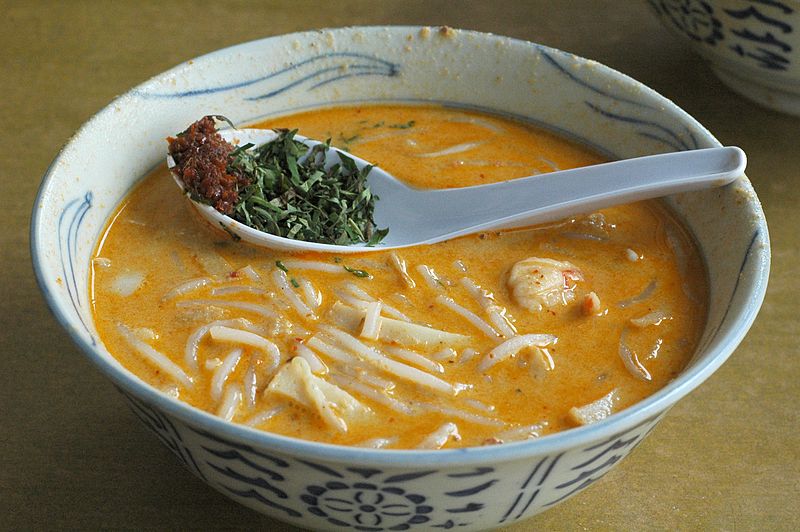
Laksa
Laksa is a bowl of thick rice vermicelli served with a unique
soupbase made with Chinese and Malay elements of cooking where there is 2
distinct types of laksas. The Peranakan version commonly sold
in Singapore is served with a curry gravy made from various spices
for fragrance, chilli for heat, coconut milk for the creamy curry gravy
together with tiny dried prawns. The key ingredient to this laksa’s unique
flavour and aroma is from the laksa leaf or otherwise known as the daun kesom. This
type of laksa used to be only enjoyed by the wealthy Peranakans but it soon
became popular in the streets of Joo Chiat area in the 1950s where this dish is
eaten with just a soup spoon.
 |
| Source: http://commons.wikimedia.org/wiki/File:Food_KatongLaksa.JPG |
Apart from the featured Chinese food above, there is so much
more Chinese food available like yong tau foo, yusheng, claypot chicken rice, curry
chicken noodles, duck noodles, char siew rice, fried rice, fish head noodles, prawn
noodles, ngoh hiang, orh luak or otherwise known as oyster omelette, fish ball
noodles, egg tart, min chiang kueh, steamed buns, pig’s organ soup, popiah, soon
kway, Teochew fish porridge, lor mee, vegetarian beehoon, kway chup, wanton
noodles, you char kway otherwise known as fried dough fritters.
Malay
Malay dishes in Singapore is very much influenced by the food of Malay
Peninsula, Sumatra and the Riau Islands. However, it is still adapted to local
tastes and may vary a little. In addition, the malay cuisine here is also influenced
by neighbouring cooking traditions of Malaysian and Indonesian (especially the
Minang cuisine). Spices and coconut milk are very commonly used together with
the usage of Chinese ingredients like tofu puffs and tofu as well. Further,
many Chinese and Indian Muslim adaptations of malay dishes also exist.
Below are the common Malay dishes eaten in hawker centres:
Lontong
Lontong is a dish made of
compressed rice cake that is shaped like an oblong wrapped inside a banana
leaf. This is a common dish found not only in Singapore but also in Indonesia
and Malaysia. The rice rolled inside the banana leaf is boiled and then cut into
smaller pieces. This dish consists of rice cakes in a coconut based soup like
sayur lodeh which contains shrimp and vegetables like chopped cabbage, turnip
and carrots. Additional condiments for this dish also include fried tempeh,
fried tofu, boiled eggs, dried cuttlefish sambal, fried spicy shredded coconut,
etc.
 |
| Source: http://www.dancingchefonline.com/wp-content/uploads/vegie-lontong-big.png |
Mee Rebus
Mee rebus is a dish made
from Chinese egg noodles in spicy gravy of tiny shrimps, flour, sugar and salt.
This gravy is then thickened with mashed sweet potato. To enhance its flavour,
herbs and spices like lemongrass, ginger and shallots are added with mutton,
prawns and ikan bilis (dried anchovies). The dish is often given a drizzle of
dark soya sauce, sliced green chillies and fried shallots together with
beansprouts, halved hard-boiled egg and thinly sliced tau kwa (fried beancurd).
A slice of lime is served on the side to be squeezed over the dish to add a
sour touch to this noodle dish. Very often, this Malay dish is eaten for
breakfast.
 |
| Source: http://i.insing.com.sg/cms/8e/73/22/78/33538/8e73227833538_600x450_a4b1b7e1a5.jpg |
Mee Siam
Mee siam is known as “Thai noodles” in Malay where Siam is
used to refer to pre-World War II Thailand. This dish is made from thin rice
vermicelli and is a popular one-dish meal in Singapore and Malaysia, especially
amongst the Malay and Peranakan communities. In Singapore, this dish is served
with a spicy, sweet and sour light gravy made from a rempah spice paste,
tamarind and taucheo (salted soy bean). Thereafter, it’s usually garnished with
shredded omelette, scallion, beansprouts, garlic chives and lime wedges.
 |
| Source: http://www.hungrygowhere.com/dining-guide/best-and-top/mad-about-mee-siam-*aid-67202b00/ |
In Malaysia, a “dry” version is more commonly found where it’s basically
frying the rice vermicelli with the same ingredients used in the Singaporean
version.
Mee Soto
The key essence of the mee soto dish is the soto ayam (chicken broth).
This broth is made from chicken cooked with rempah (spice paste). The main
ingredients used for the rempah would include ginger, garlic, galangal,
coriander, cumin, fennel, black pepper, nutmeg, curry leaves, belacan (prawn
paste) and lemongrass. If you are wondering if this are the main ingredients,
why does the soto ayam looks yellowish? This is due to turmeric that is added
to the rempah. This spicy broth is served with thick yellow noodles. Shredded
chicken is usually added as a topping together with blanched beansprouts. Extra
toppings like bergedil and sliced hard-boiled egg are very common too. This
noodle dish is usually garnished with chopped spring onions, fried onions,
Chinese celery and coriander leaves. For chilli lovers, a hot spicy black chilli
sauce is sometimes added to give it a fiery kick.
 |
| Source: http://www.the-inncrowd.com/imagesnewton/images/IMG_1061_JPG.jpg |
Nasi Padang
If you visit several Malay stalls in hawker centres, you will
commonly see nasi padang served. Nasi Padang derives its name from West Sumatra
where padang food hails. Padang food constitutes of white rice eaten with a
variety of pre-cooked dishes and condiments. Padang dishes are richly flavoured
with coconut oil, fresh chillies, lemongrass and galangal root like beef rending,
curried fish, stewed greens, stir-fried chilli eggplant, stir-fried sambal
kangkong (morning glory), curried beef liver, tripe, intestines, fried beef
lung, fried chicken, etc. Sambal is definitely one of the spicy condiments that
goes along with the dishes and rice. This kind of dining is also suitable for
communal dining as a group where dishes can be shared and a huge variety can be
enjoyed at the same time.
 |
| Source: http://hungrygrape.files.wordpress.com/2013/05/nasi-padang-offerings.jpg?w=474 |
Satay
Satay originated from the Arabs who used to skewer their meat
on swords before roasting and Middle Eastern nomads would barbecue their meat
on metal skewers in a dish known as kebab. The spice trade brought these Arab
traders to Southeast Asia and spread the Arab culinary culture to the
Indonesians and eventually Malaya. The main adaptation of this dish throughout
Asia is the use of wooden sticks instead of metal skewers.
The meats used are primarily, beef, mutton, lamb or chicken.
There is also a Chinese variation of this where pork is also used. The small
cuts of meat are marinated in various spices that aid to tenderize the meat.
After marinating the meat, the meat are skewered through wooden stocks.
Originally, satay sticks were made from dried, thin stems of the coconut leaf
but today, factory-made bamboo sticks are used. The satay is barbecued over a flaming
charcoal fire that is constantly brushed with oil for glaze until well-browned.
Satay sauce is also served with these sticks of grilled satay alongside
condiments of cut cucumber and onion. Ketupat which is also steamed rice
wrapped in woven leaf packets are also served to make it a complete meal.
The satay sauce is made from ground peanuts and other spices
where a local variation of this sauce would include a topping of pineapple puree.
 |
| Source: http://upload.wikimedia.org/wikipedia/commons/thumb/3/3c/LauPaSat_Satay.JPG/220px-LauPaSat_Satay.JPG |
Indian
Indian Singapore cuisine tends to be that of Tamil cuisine
and especially local Tamil Muslim cuisine. Indian dishes in Singapore have been
modified along the years together with other Singapore cultures according to
local tastes. Let us take a look at some of the common Indian dishes served in
Singapore.
Fish
head curry
This is an iconic dish of Singapore where it was created by a
man named Gomez who migrated to Singapore from South India in the 1950s and started
an Indian Curry stall in the Selegie area. He observed that the Chinese in
Singapore loved to eat fish heads so he cooked fish heads in his Southern
Indian Curry sauce, thus creating the fish head curry we all love.
Basically, there are two types of fish head curry where the Indian
version is spicier and heavier. This Indian version is cooked in a pot of fiery
spices that is supposed to make you sweat so that you will feel much cooler in
the hot weather. Ironic as that sounds but it does make some sense if you eat
it. The other type of fish head curry is the Chinese/Peranakan version. This
rendition would usually be such that the fish head is steamed first before
cooking in a curry which has less powdery spices and coconut milk is added to
give the curry a very nice and savoury flavour. Thus, usually this fish head
curry version tends to be a bit milder and less tangy.
 |
| Source: http://www.hungrygowhere.com/dining-guide/hawker/nonya-style-fish-head-curry-*aid-713e3f00/ |
Mee goreng
This dish is primarily made from fried noodles that is associated with South Indians. However, this is a fusion dish where it combines a mix of Chinese, Indian, European and Malay flavours where it takes the Chinese yellow egg noodles, spices and mutton commonly found in Indian cuisine, fried with a sweetness for the Malay palate and flavoured with tomato sauce which is often associated Western cuisine. It is said that this dish originated from the Muslim Chulias in Madras, India. In Malay, mee goreng means “fried noodles”. This spicy mix of egg noodles is fried with mutton or chicken together with onions, potatoes, peas, cabbages, beansprouts and topped with thinly sliced green chillies, tau kwa (grilled beancurd) and fried eggs. This noodles is stir-fried quickly with tomato ketchup and sometimes chilli. You would notice that it is often garnished with a simple tomato sauce and slices of cucumber.
 |
| Source: http://www.makansutra.com/images/story/detail/950970_mee-goreng.jpg |
Nasi
biryani
This dish is said to originate from India by the Muslim
traders and rulers. This was probably an army dish in the medieval India where
it is a one-pot rice dish which was cooked with whatever available meat they
could find. Since then, this dish became biryani due to different methods of
cooking. The most common variety of rice used for biryani is the long-grain
basmati rice. This popular Indian Muslim dish that consists of saffron rice and
meat is often sold by Indians and Malays and is an essential dish at Malay
weddings.
 |
| Source: http://sglinks.com/pages/1909953-celebrate-holiday-best-briyanis-curries |
Roti Prata (Paratha)
Roti prata is a round pancake that is often eaten with mutton
or fish curry. This dish is sold mostly by Indian Muslims at hawker centres and
is fairly cheap. For many, this is often eaten at breakfast. This dish
originates from India that has Punjabi origin as they specialized in making
various types of breads.
Flour, sugar and salt are the basic ingredients for roti
prata. Water is then added to the flour to form a stiff dough where it is
kneaded. This is important as this makes the dough soft and pliable. Upon
kneading, the dough is aired to give it a light texture. Thereafter, the dough
is divided into smaller portions and left to rest overnight. The next day, the
ball of dough is whirled and twirled from left to right and vice versa until it
is paper thin. It is then tossed onto a greased griddle where the prata is
cooked until you can see dark brown ‘blisters’ on the surface. There have been
plenty of variations like egg and onions, bananas, etc.
Similarly, in Malaysia, this dish is known as roti canai. This
version tends to be slightly fluffy, flakey and slightly crunchy on the
outside, light, soft and buttery on the inside.
 |
| Source: http://en.wikipedia.org/wiki/Roti_prata |
Peranakans
Apart from Chinese, Malay, Indian cuisine in Singapore, there
is also a uniquely authentic cuisine from the Peranakans.
Peranakans are often referred to people of mixed Chinese and
Malay/Indonesian heritage. Their ancestors are Chinese traders who married the
local Malay women. Hence, Peranakan males are known to be babas whilst the
females are known as nyonyas. The Peranakans are also known as Straits Chinese
as they are usually born in the British-controlled Straits Settlements of
Singapore, Penang and Malacca.
Although many Peranakans retained their Chinese surnames and
culture practies, they are still considered as a different group of Chinese
immigrants in Singapore as they were generally from a higher socio-economic
class.
The Peranakan culture is often described as a hybrid of
Chinese, Malay and Western cultures. You can see this through their cuisine
which is known as nyonya food. Peranakan cuisine has strong Malay and
Indonesian influences where rempah (spices) and coconut milk is used. Pork is
often used in nyonya cooking unlike in Malay cuisine where it is strictly
forbidden. Some of the signature nyonya dishes are babi pongteh (braised pork
with salted bean paste), ayam buah keluak (chicken braised in a thick, spicy
tamarind gravy with buak keluak nuts) and beef rending (beef stewed in coconut milk
and spices). Also, the Peranakans are well known for their sweet cakes which is
often referred to as nyonya kueh.
However, there are also regional variations in Nyonya cooking
as well. Nyonya dishes in Penang possess Thai influences where there is more
liberal use of tamarind and other sour ingredients like the assam laksa. Nyonya
dishes in Singapore and Malacca tend to show a greater Indonesian influence
like the use of coconut milk and nyonya laksa that is coconut milk-based is
more popular.
Despite this, there are also similar Nyonya specialities like otak otak
that is a blend of fish, coconut milk, chilli paste, galangal and herbs wrapped
in a banana leaf; Itek Tim where it’s a classic soup that consists of duck,
tomatoes, green peppers, salted vegetables and preserved sour plums simmered
gently together.
 |
| Source: http://en.wikipedia.org/wiki/Otak-otak |
 |
| Source: http://www.soshiok.com/sites/default/files/public/styles/article_main_image/public/recipe/images/featured/itek_tim.jpg?itok=8nHuZF5A |
Desserts
Kuih or kueh or kway
that is known in Singapore are bite-sized snack or dessert food that can be
commonly found not only in Singapore but also in Malaysia and Indonesia. This
is a fairly broad term that include cakes, cookies, dumplings, pudding, biscuit
or pastries in English.
Kuih is often steamed
rather than baked and is very different in texture, flavour and appearance in
comparison with its western counterparts. Many kuih are sweet but some are
savoury.
Chinese kuih
Chinese kuih or kway
are usually made from ground rice flours where some are mainly consumed for
important Chinese festivals or main meals or even snacks on a daily basis.
Some of the common ones
we can identify with are as follows:
Nian
gao
– a sticky and sweet rice cake usually associated with Chinese New Year. It is
also very popular to eat pieces of nian gao sandwiched between slices of taro and
sweet potato, dipped in batter and then, deep fried.
 |
| Source: http://en.wikipedia.org/wiki/Nian_gao |
Turnip
cake
or otherwise known as loh bak gou – a savoury dish made of shredded radish or
daikon and plain rice flour. Often, it is steamed and then cut into square
pieces when cooled. Thereafter, it will be pan-fried. This is a common Chinese
dim sum dish eaten for breakfast.
 |
| Source: http://en.wikipedia.org/wiki/Turnip_cake |
Yam
cake
or otherwise known as or kuih – a steamed savoury cake made from pieces of
taro, dried prawns and rice flour. It is topped with deep fried shallots,
spring onions, sliced chilli and dried prawns and usually served with a chilli
dipping sauce. This dish is often served for breakfast.
 |
| Source: http://en.wikipedia.org/wiki/Taro_cake |
Chwee
kueh
– a Teochew term which translates as “water rice cake”. This is a type of
steamed rice cake placed in small cup-shaped saucers. These steamed chwee kueh
are topped with diced preserved radish and served with chilli sauce. This is a
popular breakfast dish.
 |
| Source: http://www.hungrygowhere.com/dining-guide/best-and-top/chwee-kueh-*aid-c96a1a00/ |
Ang
Ku kueh otherwise known as red tortoise cake – this is a
small round or oval shaped Chinese pastry with soft sticky glutinous rice flour
skin wrapped around a sweet filling in the centre. It is moulded like a
tortoise shell and is usually ‘resting’ on a square piece of banana leaf. This
is believed by the Chinese that eating tortoises would bring longevity, good
fortune and prosperity. This auspicious sweet pastry is especially prepared for
important festivals like Chinese New Year and also a newborn baby’s first month
or birthdays of the elderly.
 |
| Source: http://singaporemochi.com/varieties-of-kuehs/ |
Malay / Peranakan
Kuehs is often eaten throughout
the day. They are a main part of the festivities in Singapore like Hari Raya
and Chinese New Year.
As in almost all Malay
and Peranakan kuih, ingredients like grated coconut, coconut cream, pandan
leaves and gula Melaka are very common. Although those make up for the flavour
of the kuih, their base and texture are built on starches like rice flour,
glutinous rice flour, glutinous rice and tapioca. Nyonya (Peranakan) and Malay
kuih are distinctly similar as many Malay kuih have been improved and retained
by the Peranakans.
Below are the examples
are the common kuih muih in Singapore:
Curry puff
A curry puff is a
deep-fried, crescent-shaped pastry filled with curried potato and meat. This is
believed to be inspired by the British cornish pastry that was introduced to
the Malay Peninsula with the arrival of the British.
In post-war Singapore,
Malay ladies often sold epok-epok from door to door. The Malay epok-epok (curry
puff) is a fried pastry filled with sardines or potatoes flavoured with a
rempah (spice) of chillies but without curry. Very soon, the Chinese also
adopted this popular Malay snack and modified it by adding a slice of
half-boiled egg in the potato curried version which is the curry puff we often
see in Singapore. Clearly, you would also notice that in Malaysia, epok epok is
like the Malay version we see in Singapore.
 |
| Source: http://www.hungrygowhere.com/dining-guide/best-and-top/curry-puff-*aid-e1780100/ |
You would probably see
many variations of curry puff in Singapore where some have fillings of chicken
and onion but no potatoes and some made it into the layered, flaky pastry
influenced by Teochew mooncakes.
 |
| Source: http://www.hungrygowhere.com/dining-guide/best-and-top/curry-puff-*aid-e1780100/ |
|
Kueh Lapis
This version of kueh
lapis is different from kek lapis. This is a Nyonya steamed cake made out of
rice flours, starches and water unlike its kek lapis cousin that is made of
butter, wheat flours, eggs and sugar.
 |
| Source: http://www.halfhourmeals.com/recipe/kueh-lapis-nyonya/ |
Kueh tutu
Kuih tutu is a small
steamed cake made of finely pounded rice flour and filled with either ground
peanuts or grated coconut. This dish is said to originate from the Fujian
province of China and is unique to Singapore after modifications made to the
original dish. In 1980s, Singaporean Tay Low Long designed steam carts and
moulds in stainless steel to make this kuih. The name of this kuih is derived from
the sound made by the charcoal heated steamers that were used to cook these
cakes in the past,
Traditionally, the
flour used in kuih tutu is made by pounding rice grains rather than grinding
them and the resulting flour is sifted several times to make it snow white and
light.
Kuih tutu is made by
steaming rice flour in a special mould. The mould is filled with finely pounded
flour. A portion of the filling is taken out to make space for the filling. The
grated coconut filling is fried on low heat over several hours and sweetened with
gula Melaka. Another layer of rice flour is added to seal the filling and the
kuih is tipped over onto a muslin cloth placed on the steamer. The cakes look
like little flowers as a result of the mould used. This kuih is placed on a
small piece of pandan leaf to acquire a sweet flavour and scent.
 |
| Source: http://en.wikipedia.org/wiki/Kueh_tutu |
Apart from desserts, there is also a large variety of desserts sold in hawker centres or foodcourts in Singapore like cheng tng, ice kachang, chendol, tangyuan etc which are also seen in its neighbouring countries like Malaysia.
Having seen so much of Singapore cuisine, you can obtain more inspiration and ideas on Singaporean dishes from some of the following links:
If you are stumped on what to cook or bake due to the extensive list of food items in Singapore cuisine, you may head to the nearest hawker centre or food court in Singapore. You will be inspired by so many flavours and cuisines available.
So let's join in the fun for this finale and prepare a Singapore dish. It can be savoury or sweet, whichever that is your kind of thing.
To join:
- Who can join? Anyone can join.
- Prepare a dish (sweet or savory) that is from Singapore, be it old time classics, modern yummies or dishes that has been localized. Take a picture of the food or many pictures.
- Provide recipe that is credited (from books, internet, friends or family or your own, be specific). Submissions without stating recipe sources will not be accepted for all forms of submission.
- Submit your entry latest by 30th September 2014.
To submit:
Bloggers
- Prepare a dish (sweet or savoury) that is from Singapore.
- Blog about it from 1st September 2014 – 30th September 2014
- Include this caption below your blog post
“I am submitting this post to Asian Food Fest #11 Sept 2014 : Singapore hosted by Life can be Simple”.
Submit your entry via the link provided at the end of this blog post.
Facebook user
Bloggers may also submit old recipes to Facebook, but please state “OLD BLOG POST”. Anyone that has once cooked a Singaporean dish and have a picture and recipe can submit to Facebook. This need not necessarily be a recently done dish.